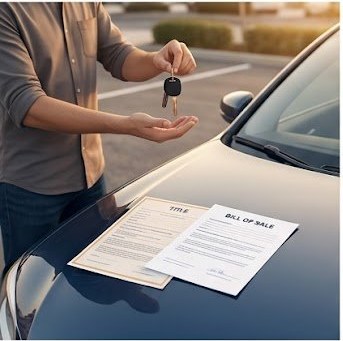
Complete the title paperwork before handing over keys in any private vehicle sale.
Why Private Sales Are Different
When you buy a car from a licensed dealership, the process is straightforward: the dealer issues a temp tag as part of the sale. Private sales — between two individuals — don't work this way. Private sellers are not licensed dealers and cannot issue official temporary plates.
This creates a practical problem: how do you legally drive the car home? The answer varies significantly by state.
The Three Main Private Sale Models
States handle private sale temp tags in roughly three ways:
- DMV/county trip permit: You (the buyer) visit the local DMV or county office before or shortly after the sale to obtain a short-term transit permit. You'll need the signed title, bill of sale, and proof of insurance. This is the most common model.
- Seller's plates: In some states, the seller's registration allows the buyer to drive the vehicle for a very brief period (often 24–72 hours) strictly for the purpose of getting it registered. This is a narrow exception and often misunderstood as broader than it is.
- Immediate registration required: A few states require you to register the vehicle (or get a permit) before you drive it at all, which may mean having the seller accompany you to the DMV first.
The biggest mistake private-sale buyers make is assuming the seller's plates are valid for the trip home. In most states, using a seller's plates after a sale is illegal — the plates belong to the seller's registration, not the vehicle. Research your state's rules before the transaction, not after.
Documents You'll Need
To obtain a private sale temp tag at your state DMV or county office, you'll typically need:
- Signed vehicle title — The seller must sign the title over to you. Both buyer and seller signatures are required in most states.
- Bill of sale — A written record of the sale including the vehicle details, sale price, date, and both parties' names and signatures. Some states have official bill of sale forms; others accept any written document.
- Proof of insurance — Active liability insurance policy that covers the vehicle you're purchasing. You'll need this before the temp permit is issued in most states.
- Valid ID — Driver's license or state ID.
- Payment — Fees for the transit permit, which vary by state but typically range from $0–$30.
Checking for Liens Before the Sale
This is the most important step many private buyers skip. If the vehicle has an outstanding lien (the seller still owes money on it), the title will not be free and clear. The lender may hold the physical title, making it impossible to transfer ownership to you.
Always verify before purchase:
- Run a VIN check through your state DMV website or a paid service like Carfax or AutoCheck
- Ask the seller for the title and inspect it before handing over money
- If there is a lien, require the seller to pay it off and obtain a lien release before completing the sale
State-Specific Private Sale Notes
Several states have unusual rules worth knowing:
- Idaho and New Mexico: In some cases, the seller must accompany the buyer to the DMV to complete the transfer and obtain a temp permit in person.
- Mississippi: Has no formal private-sale temp permit system — buyers are generally expected to register the vehicle at the county tax collector's office immediately or drive it home the day of purchase under the narrow seller's-plates exception.
- New Hampshire: Unlike most states, dealers in NH cannot issue temp plates — all temp plates (including for new cars) are issued through the town clerk. This applies to private sales as well.
- Rhode Island: Issues only 5-day transit permits for private sales — by far the shortest in the nation. The permit is strictly for getting the vehicle to the DMV for registration.
Find your state's specific rules in the state directory.
TOURSUIT Car Registration & Insurance Card Holder — #1 Best Seller
Every guide on this site says to keep your bill of sale, insurance card, title copy, and temp tag in the vehicle at all times. This #1 Best Seller glovebox organizer has 4.8★ from 11,000+ buyers — it holds everything flat, protected from rain that can make a paper temp tag unreadable and legally void.
🛒 View on AmazonNegotiating the Sale Price to Account for Registration Costs
One aspect of private vehicle purchases that buyers often overlook: the registration fees, title transfer costs, and sales or use taxes you'll pay at the DMV when getting your temp tag are a real additional cost on top of the sale price. Depending on the state, these can add 5-10% to the effective cost of the vehicle.
Smart private-sale buyers factor these costs in before agreeing to a price. Research your state's rates in advance (see the state pages on this site for specifics) and consider them when negotiating. In high-tax states like California (7.25%+ use tax), Illinois (6.25%+), and New York (8%+), the tax alone on a $20,000 vehicle adds $1,450 to $2,000+ to your out-of-pocket cost.
What Happens If the Seller Won't Sign the Title?
Occasionally, a buyer completes a private sale only to have the seller become unresponsive, unwilling to provide the title, or produce a title they cannot legally sign (because of a lien, incorrect name, or other complication). Options in this scenario:
- Stop payment immediately if the transaction has not fully cleared. Do not complete payment until you have the properly signed title in hand.
- Contact your state's DMV about a bonded title or alternative title pathway. Most states have a process for buyers who have a vehicle but cannot obtain a clean title from the seller.
- File a police report if you have paid and the seller is withholding the title. Refusing to transfer a title after a completed sale can constitute fraud in most states.
- Consult a consumer protection attorney if the amount involved is significant. Small claims court is appropriate for amounts under the court's limit (typically $5,000-$10,000 depending on state).
The single most important rule in private vehicle purchases: do not hand over final payment until the signed title is in your hands. Sellers who cannot produce a title at time of purchase — for any reason — should be treated as a significant red flag regardless of how credible their explanation sounds.